Discover how Voyager 1 reached one light-day from Earth in 2026. Explore its 25.9 billion km journey, NASA's campaign and deep-space communication.
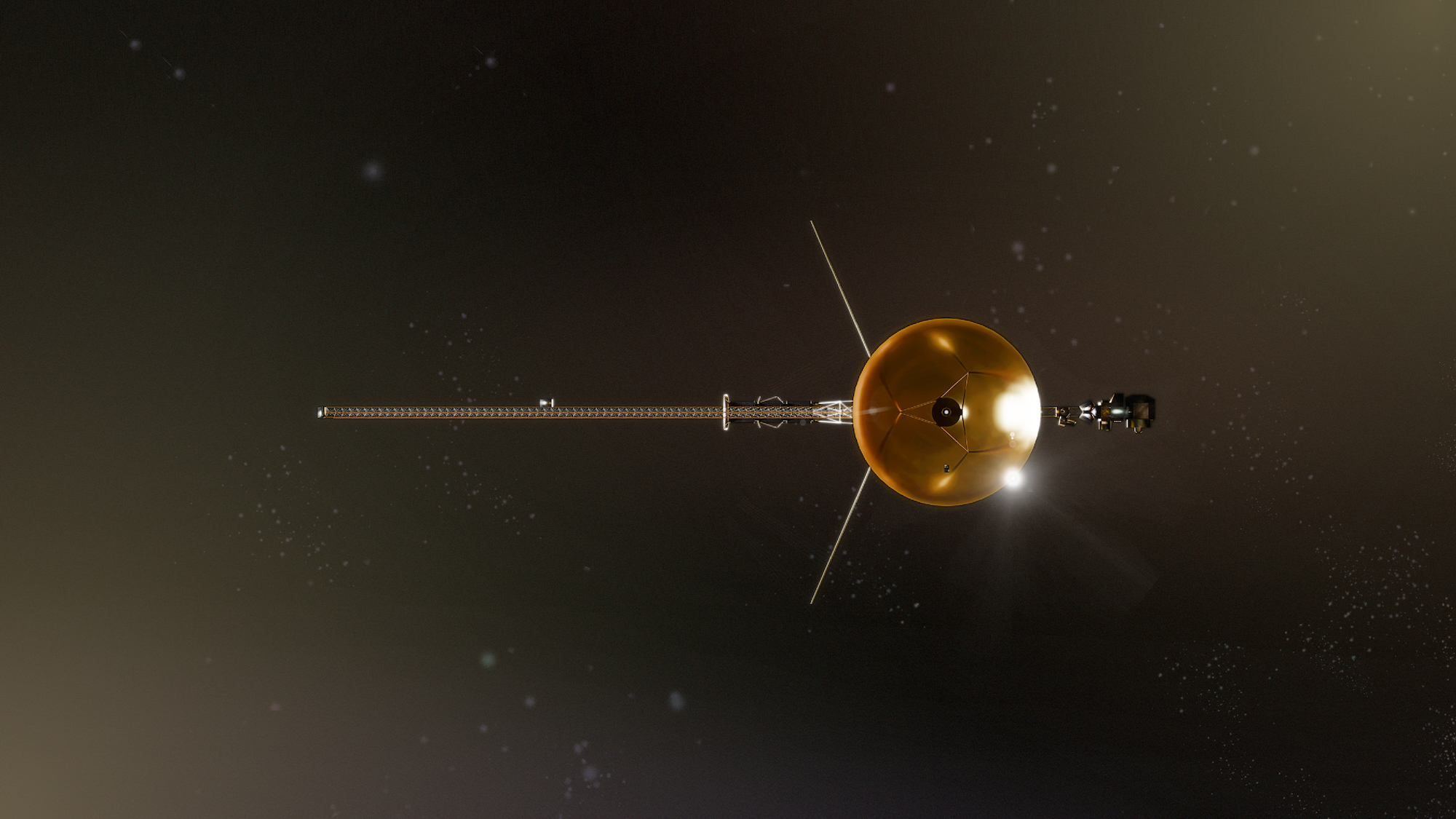
On 18 November 2026, NASA's Voyager 1 reached a distance that no other human-made object had ever reached before: one light-day from Earth.
After travelling through space for nearly 50 years, the spacecraft is now approximately 25.9 billion kilometres away from our planet. At this distance, even a signal travelling at the speed of light takes an entire 24 hours to reach it.
Think about that.
If NASA sends a command to Voyager 1, it takes approximately one full day for the signal to arrive. When the spacecraft responds, the message takes another day to travel back to Earth.
That means a simple communication exchange can take approximately 48 hours.
This is what makes the one-light-day milestone so remarkable. It is not just about how far Voyager 1 has travelled. It demonstrates the extraordinary engineering behind one of humanity's longest-running space missions and the challenges of communicating with a spacecraft billions of kilometres away.
But what exactly is a light-day? How far is Voyager 1 from Earth? Why does this milestone matter? And how did NASA invite people around the world to celebrate it?
Let's explore the science, engineering and history behind this remarkable achievement.
What Is One Light-Day?
A light-day is a unit of distance that represents how far light travels through space in 24 hours.
Light travels at approximately 299,792 kilometres per second. At this speed, it covers an extraordinary distance every minute, hour and day.
Here is what that means:
• In one second: Approximately 299,792 kilometres
• In one minute: Approximately 18 million kilometres
• In one hour: Approximately 1.08 billion kilometres
• In 24 hours: Approximately 25.9 billion kilometres
Therefore, one light-day is approximately 25.9 billion kilometres or 16.09 billion miles.
It is important to understand that a light-day measures distance, not time. The name describes the distance light can travel in one day.
For comparison, sunlight takes approximately 8 minutes and 20 seconds to reach Earth. But a signal travelling from Earth to Voyager 1 now takes approximately 24 hours.
That is the scale of the distance Voyager 1 has travelled.
To understand the milestone through NASA's own resources, explore the official
How Far Is Voyager 1 from Earth?
On 18 November 2026, Voyager 1 reached the one-light-day distance milestone.
Here are the approximate measurements associated with this achievement:
Distance in kilometres: 25.9 billion km
Distance in miles: 16.09 billion miles
Distance in astronomical units: Approximately 173 AU
One-way signal travel time: Approximately 24 hours
An astronomical unit, or AU, is the average distance between Earth and the Sun, approximately 150 million kilometres.
At around 173 AU, Voyager 1 is approximately 173 times farther from the Sun than Earth is.
It is the first human-made object to reach a distance of one light-day from Earth.
The achievement is particularly remarkable because Voyager 1 was launched in 1977, when modern smartphones, commercial GPS systems and today's advanced computing technologies did not exist.
You can follow NASA's mission information and learn more about the spacecraft through the
Why Is Reaching One Light-Day Such a Big Deal?
To understand the importance of this milestone, we need to understand how communication works in space.
Radio signals travel at approximately the speed of light. NASA uses these signals to send commands to spacecraft and receive scientific information from them.
At a distance of one light-day, the communication process works approximately like this:
1. NASA sends a command from Earth.
2. The radio signal travels for approximately 24 hours.
3. Voyager 1 receives the command.
4. The spacecraft processes the instruction and sends information back.
5. The response takes approximately another 24 hours to reach Earth.
This creates a communication round trip of approximately 48 hours.
Unlike spacecraft operating closer to Earth, Voyager 1 cannot be controlled through immediate, real-time communication.
Engineers must plan commands carefully, anticipate possible technical problems and design systems capable of operating independently for extended periods.
This is one of the most fascinating engineering challenges of the Voyager mission.
The distance also makes Voyager 1 an extraordinary example of how radio communication, antenna technology and signal processing work together in deep-space exploration.
NASA's "Shine Bright for Voyager's Light-Day" Campaign
Voyager 1's one-light-day milestone was not celebrated only inside NASA's mission control centres.
NASA invited people around the world to participate in a public campaign called "Shine Bright for Voyager's Light-Day".
The campaign was organised around the milestone, with the main participation activity taking place on 17 November 2026, ahead of Voyager 1 reaching one light-day on 18 November.
The idea was simple but meaningful.
People were encouraged to point a light towards the sky and flash the letters V-G-R using Morse code. VGR is the mission call sign associated with the Voyager spacecraft.
Participants could use their smartphones, phone torches, flashlights, glow sticks or other light sources.
Here is how to flash VGR in Morse code:
V: Three short flashes followed by one long flash.
G: Two long flashes followed by one short flash.
R: One short flash, one long flash and one short flash.
NASA also provided an automated V-G-R flasher for smartphones and tablets, making it easier for people to participate.
Participants were encouraged to photograph or record their signals and share them on social media using the campaign instructions and NASA's official account, @NASA.
It is important to clarify that these flashes were symbolic. They were not signals being transmitted to Voyager 1. The campaign was designed to bring people together to celebrate how far human exploration has travelled.
You can explore the original campaign and its participation instructions here:
You can also access NASA's official downloadable posters, graphics and other campaign resources:
Voyager 1: Nearly 50 Years of Space Exploration
To understand the significance of this achievement, we need to go back to 1977.
NASA launched Voyager 1 on 5 September 1977, following the launch of its twin spacecraft, Voyager 2, on 20 August 1977.
Both spacecraft were designed to explore the outer planets of our Solar System. Their missions eventually took them much farther than their original planetary exploration objectives.
Some of Voyager 1's most important milestones include:
1977: Voyager 1 launched from Earth.
1979: Voyager 1 conducted its Jupiter flyby and sent back valuable observations of the planet and its moons.
1980: The spacecraft conducted its Saturn flyby, studying the planet, its rings and its moons.
1990: Voyager 1 captured the famous Pale Blue Dot image, showing Earth as a tiny point of light from an enormous distance.
2012: Voyager 1 crossed the heliopause and entered interstellar space.
2026: Voyager 1 reached the one-light-day distance milestone from Earth.
The spacecraft's journey has helped scientists understand the outer Solar System and the environment beyond the Sun's influence.
Its achievements are not limited to distance records. Voyager 1 has fundamentally changed how we understand our place in the Solar System.
For more about the history, discoveries and objectives of this mission, visit
Is Voyager 1 Outside the Solar System?
This is one of the most frequently asked questions about Voyager 1.
The answer depends on how we define the boundary of the Solar System.
Voyager 1 entered interstellar space on 25 August 2012 after crossing the heliopause.
The heliopause is the boundary where the outward influence of the solar wind becomes dominated by the surrounding interstellar environment.
However, entering interstellar space does not necessarily mean that Voyager 1 has left every outer region associated with the Solar System.
The Solar System also includes the distant Oort Cloud, a vast, theoretical region of icy objects believed to surround the Sun.
Therefore, Voyager 1 is travelling through interstellar space, but it still has an enormous journey ahead before it could be considered beyond the Solar System in the broadest sense.
NASA explains this distinction in its
How Fast Is Voyager 1 Travelling?
Voyager 1 is travelling at approximately 17 kilometres per second relative to the Sun, equivalent to around 61,000 kilometres per hour.
That is incredibly fast by human standards.
However, even at this speed, the spacecraft took nearly five decades to reach a distance that light can travel in just 24 hours.
Consider the difference:
Light: Approximately 299,792 kilometres per second.
Voyager 1: Approximately 17 kilometres per second.
Commercial aircraft: Approximately 900 kilometres per hour.
Voyager 1 is one of the fastest spacecraft ever sent into deep space, but it is still moving far slower than light.
This comparison helps explain why interstellar distances are so difficult to cover using conventional spacecraft propulsion technologies.
How Does NASA Still Communicate with Voyager 1?
One of the most fascinating aspects of Voyager 1 is that it continues to communicate with Earth despite its extraordinary distance.
NASA uses the Deep Space Network, commonly known as the DSN, to communicate with distant spacecraft.
The Deep Space Network consists of large radio antenna facilities located at three major complexes around the world:
• Goldstone, California, United States
• Madrid, Spain
• Canberra, Australia
These facilities work together to maintain communication with spacecraft across different regions of the sky.
Voyager 1 uses its high-gain antenna to transmit signals towards Earth. Because the spacecraft is so far away, the signals reaching our planet are extremely weak.
The Deep Space Network uses highly sensitive antennas and sophisticated communication systems to detect and decode these signals.
However, communication is not instantaneous. At a distance of one light-day, a signal takes approximately 24 hours to travel in either direction.
This makes Voyager 1 one of the most challenging long-distance communication projects in the history of space exploration.
You can also see information about the network's antenna activity through
[NASA's DSN Now]
How Does Voyager 1 Generate Power After Nearly 50 Years?
Voyager 1 does not use solar panels to generate its electricity.
At its enormous distance from the Sun, sunlight is too weak to provide a practical source of electrical power for its instruments and communication systems.
Instead, Voyager 1 uses a Radioisotope Thermoelectric Generator, commonly known as an RTG.
An RTG converts heat produced by the natural radioactive decay of plutonium-238 into electrical energy.
It is not a nuclear reactor. It generates electricity by converting the heat released through radioactive decay.
However, the electrical power available from the RTG gradually decreases over time.
NASA engineers have therefore had to switch off selected instruments and spacecraft systems to conserve the remaining energy.
This is an extraordinary example of long-term engineering. A spacecraft designed in the 1970s continues to operate because its engineers planned for an environment where physical repairs, servicing and regular maintenance would be impossible.
You can learn more about the spacecraft's design and systems through
[NASA's Voyager spacecraft information]
Voyager 1 vs Voyager 2: What Is the Difference?
Voyager 1 and Voyager 2 are twin spacecraft, but they followed different trajectories and explored different planetary environments.
Voyager 1 was launched on 5 September 1977, while Voyager 2 was launched earlier, on 20 August 1977.
Their major mission differences include:
Voyager 1:
• Jupiter flyby: 1979
• Saturn flyby: 1980
• Entered interstellar space: 2012
• Reached one light-day from Earth: 18 November 2026
Voyager 2:
• Jupiter flyby: 1979
• Saturn flyby: 1981
• Uranus flyby: 1986
• Neptune flyby: 1989
• Entered interstellar space: 2018
Voyager 1 travelled on a trajectory that took it beyond Saturn and towards interstellar space.
Voyager 2 followed a different path, allowing it to become the first and, so far, only spacecraft to visit Uranus and Neptune.
Both spacecraft continue to provide scientists with valuable information about the environment beyond the heliosphere.
For the latest mission information, explore
NASA's Voyager 1 and Voyager 2 location page
What Is the Golden Record on Voyager 1?
Voyager 1 carries something that makes its mission especially meaningful beyond science and engineering: the Golden Record.
The Golden Record is a gold-plated copper disc containing sounds, images, music and greetings from Earth.
It was designed as a message representing humanity and our planet, should the spacecraft ever be encountered by an intelligent civilization.
The record includes greetings in 55 languages, natural sounds, music and scientific information.
It contains sounds of Earth, including thunder, wind, birds and human voices, alongside selected music and images representing life and civilisation on our planet.
The Golden Record is more than a technical component. It represents how humanity chose to introduce itself to the universe.
Even after travelling for nearly 50 years, Voyager 1 continues to carry this message into interstellar space.
You can explore the history and contents of the record through
[NASA's Voyager Golden Record resources]
What Can Engineering Students Learn from Voyager 1?
Voyager 1 is not just a story about astronomy. It is also a remarkable engineering case study.
Its mission brings together several important engineering disciplines.
Electronics and Embedded Systems
Voyager 1 demonstrates the importance of designing electronic systems that can operate reliably for decades in extreme environments.
Communication Engineering
The spacecraft relies on radio communication to transmit scientific data across billions of kilometres. Its mission highlights the challenges of signal strength, antenna design and long-distance communication.
Power Systems
The RTG demonstrates how engineers can generate and manage electrical energy when conventional power sources are unavailable.
Thermal Engineering
Spacecraft systems must be designed to operate within suitable temperature limits despite extreme environmental conditions.
Control Systems
Voyager 1 must maintain its orientation and antenna alignment to communicate with Earth and operate its instruments.
Data Collection and Instrumentation
The spacecraft carries scientific instruments that collect information about particles, magnetic fields and plasma in the interstellar environment.
For students interested in aerospace engineering, electronics, robotics and space technology, Voyager 1 demonstrates how multiple engineering disciplines work together in a real space mission.
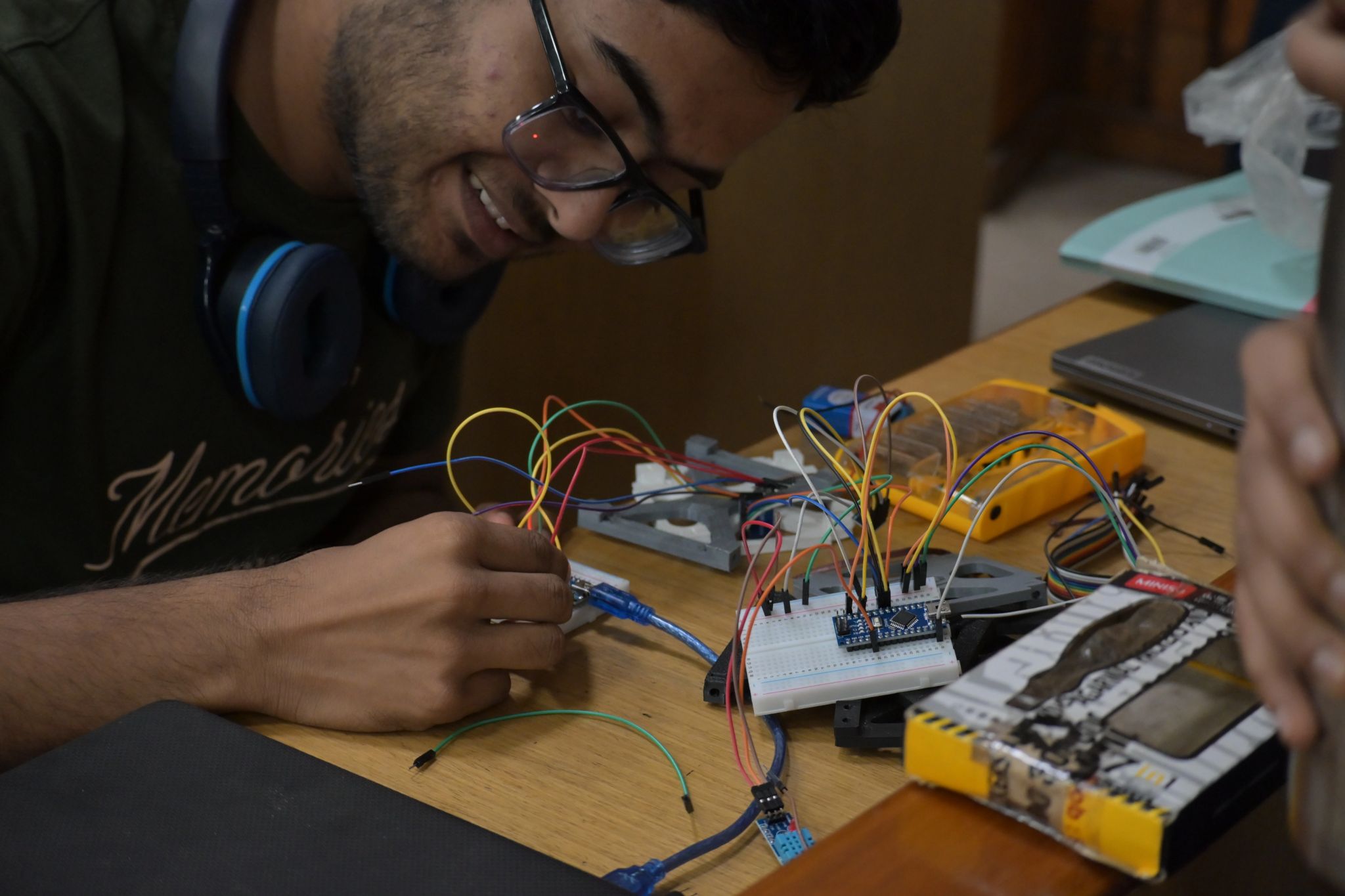
At Hexstar Universe, we believe that understanding space technology becomes more meaningful when students can experiment with the underlying engineering concepts.
Our educational CubeSat Kit introduces students to satellite subsystems, sensors, telemetry and hands-on satellite technology.
Explore the [Hexstar Universe CubeSat Kit]
Students interested in smaller satellite mission concepts can also explore our CanSat Kit, which introduces practical payload design, data collection and telemetry.
Explore the [Hexstar Universe CanSat Kit]
These educational platforms offer a way to connect the engineering ideas behind missions like Voyager with practical learning experiences.
What Happens to Voyager 1 Next?
Voyager 1 will continue travelling through interstellar space, moving farther away from Earth.
Its available electrical power will gradually decline, which means NASA engineers must carefully manage its remaining energy and scientific instruments.
Eventually, the spacecraft will no longer be able to communicate with Earth.
But its journey will not stop when communication ends.
Voyager 1 will continue moving through space, carrying the Golden Record long after its instruments stop operating.
Its mission is a reminder that engineering achievements can outlast the technologies and generations that created them.
You can follow the mission through
One Light-Day, Nearly 50 Years and a Remarkable Human Achievement
Voyager 1 reaching one light-day from Earth is more than a record-breaking distance.
It represents nearly five decades of engineering, scientific discovery, problem-solving and human curiosity.
A spacecraft built in the 1970s has travelled farther than any other human-made object and continues to send information from a region of space that no human has ever visited.
And perhaps the most interesting part is this: even after reaching one light-day, Voyager 1 is still moving.
The spacecraft will continue its journey long after the people who designed, built and launched it are gone.
Its story reminds us that some of humanity's greatest achievements begin with a simple question:
How far can we go?
Explore more about space technology, satellite engineering and hands-on learning with Hexstar Universe.
Has Voyager 1 reached one light-day from Earth?
Yes. Voyager 1 reached the one-light-day distance milestone on 18 November 2026. It became the first human-made object to travel approximately 25.9 billion kilometres, or 16.09 billion miles, from Earth.
What is one light-day in kilometres?
One light-day is approximately 25.9 billion kilometres. It represents the distance light travels in 24 hours at approximately 299,792 kilometres per second
How long does it take to send a signal to Voyager 1?
A radio signal travelling at the speed of light takes approximately 24 hours to reach Voyager 1 at the one-light-day distance. A round-trip communication can therefore take approximately 48 hours.
How far is Voyager 1 from Earth in miles?
At the one-light-day milestone, Voyager 1 was approximately 16.09 billion miles from Earth.
Is Voyager 1 the farthest human-made object from Earth?
Yes. Voyager 1 is the most distant human-made object from Earth and became the first to reach the one-light-day distance milestone.
How fast is Voyager 1 travelling?
Voyager 1 travels at approximately 61,000 kilometres per hour relative to the Sun. Its speed is much slower than the speed of light.
How does Voyager 1 get electricity?
Voyager 1 uses a Radioisotope Thermoelectric Generator, or RTG, which converts heat from the radioactive decay of plutonium-238 into electricity.
What was NASA's Shine Bright for Voyager campaign?
NASA's Shine Bright for Voyager's Light-Day was a public participation campaign organised around the spacecraft's one-light-day milestone. People were invited to flash V-G-R in Morse code using phones or flashlights to symbolically celebrate Voyager 1's journey.
Can we still communicate with Voyager 1?
NASA continues to communicate with Voyager 1 through its Deep Space Network. However, signals take approximately 24 hours to travel in either direction at the one-light-day distance.
Official Sources and Further Reading
The following resources provide authoritative information about the Voyager mission, its technology, its scientific discoveries and the one-light-day campaign.
1. NASA – Voyager Mission Overview
2. NASA – Voyager 1 Mission
3. NASA – Voyager One Light-Day Downloads
4. NASA – Shine Bright for Voyager's Light-Day
5. NASA – Where Are Voyager 1 and Voyager 2 Now?
6. NASA – Voyager Spacecraft
7. NASA – Voyager Scientific Instruments
8. NASA – Voyager Frequently Asked Questions
9. NASA – Deep Space Network
10. NASA – Deep Space Network Now
11. NASA – Voyager Golden Record
12. NASA – Voyager Fact Sheet